For my Level 5 studies I elected to take the Experimental Film and Video strand as it is a genre of film that I feel more comfortable with as a viewer, rather than mainstream Hollywood studio productions.
My favourite films and film genres all have an unconventional, quirky aspect to them. I like to watch European, British, independent and experimental movies.
My favourite directors are Peter Greenaway, Derek Jarman, Ken Russell, Lars Von Trier, Pedro Almodovar, Bernardo Bertolucci, Bruce Weber and Pier Paolo Pasolini. There are many others too whose works have fascinated and entertained me but by far and away my favourite films are by Peter Greenaway and Derek Jarman.
I love the work of both film makers because of their dreamlike, 'other-worldy' films using various inventive and unconventional techniques to tell a story or depict an image, a scene or an emotion.
Works that stand out for me include Peter Greenaway's adaptation of Shakespeare's The Tempest, Prospero's Books, which uses on screen text, long sweeping shots on huge sets, picture in picture, overlays and voiceover to great effect.

Prospero's Books
I also love Greenaway's films Drowning by Numbers and A Zed and Two Noughts which use, as indeed all his films do, wonderful, experimental techniques and are visually amazing to watch. Greenaway uses sequences and references throughout his films that connect with the viewer.
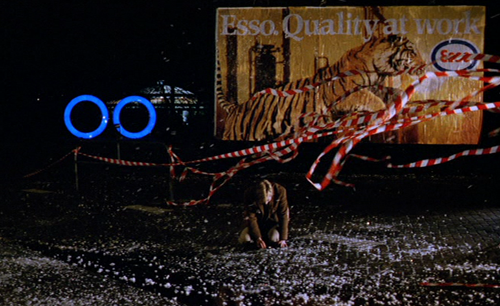
A Zed and Two Noughts
Derek Jarman began his career as a set dresser for Ken Russell on his production of The Devils and went on to become one of the most experimental British film makers from the seventies to his death in 1994, creating striking, and often controversial, films using groundbreaking techniques, interesting use of language, casting, imagery, use of Super 8 and video transfer, editing, sets and locations to create wonderful surreal films.
My favourite Jarman films are Sebastiane, an historical piece which included the entire script written and performed in latin, Jubilee which was an apocalyptic portrayal of a decrepit Britain in the punk era of the late seventies and early eighties and his interpretation of Shakespeare's The Tempest.

I am also fascinated by his short, early experimental films such as The Art of Mirrors and The Garden of Luxor which play with imagery, colour and over lays to create intriguing and beguiling films.


Derek Jarman's short experimental
film Art of Mirrors (1973) plays with how light and colour can be used
in film and how they are shown on screen. Jarman experimented with
colour filters and reflected light in this film. In his later films,
reflected light, stage lighting and colour (and filters) played a large
part in the design and look of the films. For example, in The Tempest
when Ferdinand is washed ashore from a strong sea Jarman used a blue
filter which is in stark contrast to the natural candle and firelight
that he used to illuminate Prospero's rooms. He also uses
non-conformist, experimental techniques in his films such as The Garden
which has many seemingly detached images and scenes, quick edits and
heavy use of filters and lights to make the footage appear surreal.

Still from The Garden
In the Garden of Luxor (1972) Jarman experimented with multilayering as well as colour filters. He ran scenes with characters and scenes of Egypt under a layer of scenes of a garden and during the scenes slowly changed the colour of the scenes using filters on the lights and colour filters on the footage.


In his film Blue Jarman employs a very bold technique, he relies only on voiceover as the visual throughout the entire film is a blue screen, thus concentrating the viewer's attention to the words.
Ken Russell is amongst my favourite directors and figures within the film industry. He was an experimental director that had the courage to try out different styles of staging and cuts, and he understood characters (and their fouibles) and turned stories, characters, settings, framing and light into the most wonderful visual experiences.
Cinema
needs creative, eccentric people to keep pushing boundaries, to try new
ideas, to question what is the norm and to be controversial and
inspirational. We need more people like Ken Russell to keep film
exciting. I'm glad he leaves such a huge body of work, and for the
effect that he has had on contemporary cinema, and on me.


http://thefilmexperience.net/blog/2011/11/28/rip-ken-russell.html
http://www.scotsman.com/lifestyle/film/film-reviews/profile_ken_russell_a_look_back_on_the_career_of_british_cinema_s_original_sinner_1_1987957
World famous photographer Bruce Weber is best known for his fashion photography, particularly the 'Americana' style black and white photos that he does for the Abercombie & Fitch, Versace and Calvin Klein campaigns.


As well as his amazing photography he is also one of my favourite film makers having made four feature films; Letter to True, Broken Noses, Chop Suey and Let's Get Lost. Probably his most well known films are the very well respected Let's Get Lost which follows the career of jazz musician Chet Baker and Broken Noses which follows the lives of young amateur boxers in America.


As with his photography Bruce works mostly in black and white for his films. As well as the feature films he has done many music videos, including the Pet Shop Boys 'Being Boring' video, and many short and experimental films. His two self proclaimed experimental films are very different from each other: Red Flag Day follows the training session of a group of athletic American high school wrestlers with sound bites from interviews played over the top. This is in black and white and could almost be a campaign ad for Abercombie & Fitch. The second film that he classes as experimental is Tough Guys Wear Pink which chops footage of South American working class families with stylised images and footage of attractive, carefree American teenagers engaged in recreational activities and has sound bites and on screen text.


I would also argue that Bruce Weber's feature film Chop Suey is an experimental film as it contains hundreds of short edits of images and footage along with documentary footage, old photographs, voiceovers, phone calls and seemingly random music and pictures. Weber also uses colour filters and a mix of black and white and colour images.
I love Bruce Weber's films and highly recommend the Bruce Weber collection. As I love photography, interesting composition and the use of light and shadow (particularly in black and white images and films) I find Bruce Weber's films and photographs interesting and wonderful to look at.

http://www.bruceweber.com/

No comments:
Post a Comment